
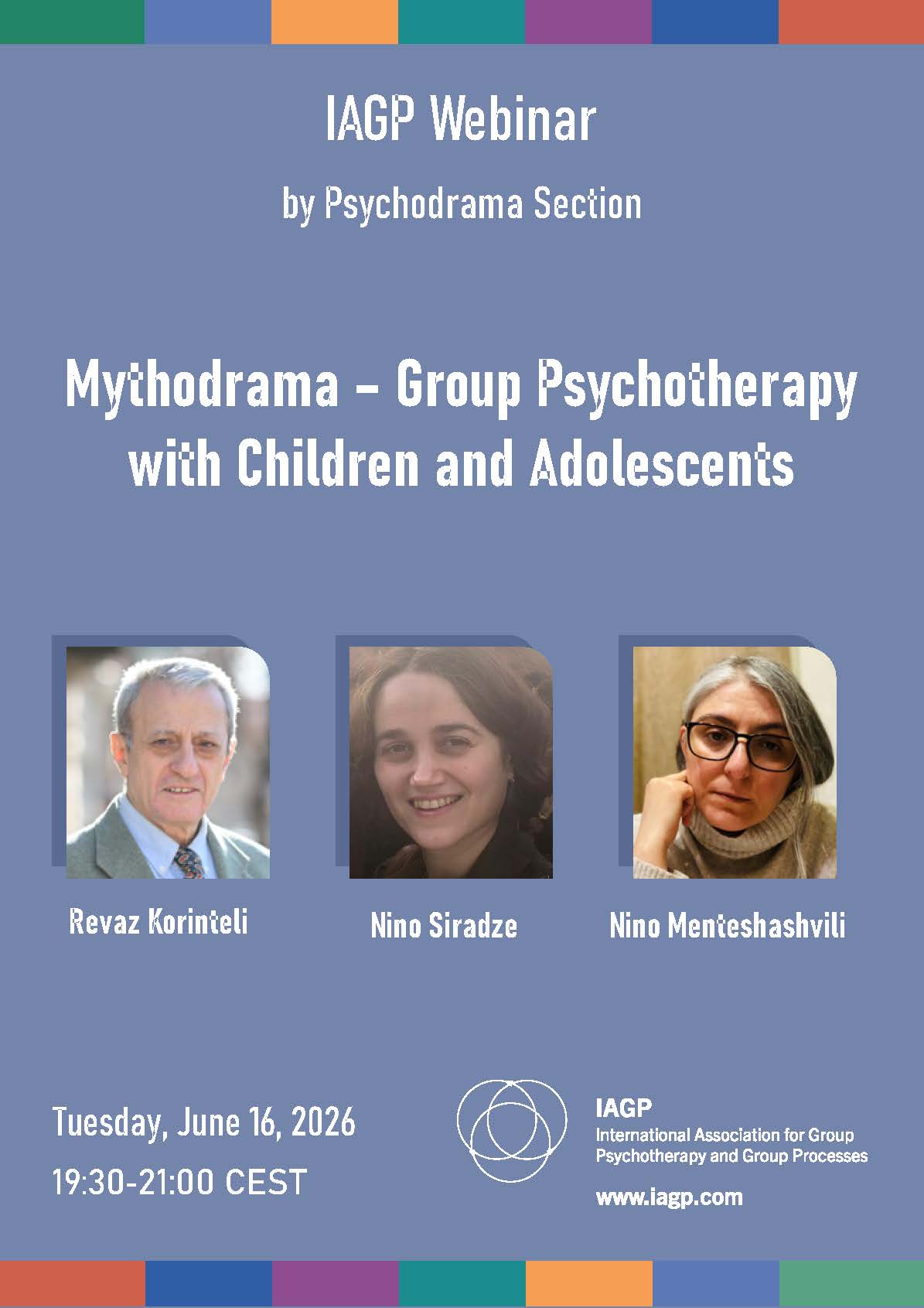
 We warmly invite you to join us on June 16th, 19:30–21:00 CET for an engaging webinar on Mythodrama—Group Psychotherapy with Children and Adolescents, led by Revaz Korinteli, Nino Menteshashvili, and Nino Siradze from Tbilisi, Georgia.
Registration link: https://us02web.zoom.us/meeting/register/8c6nLrFMSd-dQHS99nNMfw
About the Presenters:
Revaz Korinteli, MD, FAGPA, Professor, Ilia State University, Tbilisi, Georgia
Nino Menteshashvili, MA, Psychologist, Mythodrama psychotherapist, Jungian analyst, Tbilisi, Georgia
Nino Siradze, MA, Psychologist, Mythodrama psychotherapist, Jungian analyst, Tbilisi, Georgia
Abstract:
Mythodrama is a short-term group psychotherapy method designed to alleviate emotional and conduct problems, including violence and crises in schools, interpersonal conflicts, problems of self-esteem and dealing with different emotions, etc. It functions both as an intervention and a prevention program.
The Mythodrama method was developed by the Swiss psychologist and psychotherapist Allan Guggenbühl, who works in the field of juvenile psychology. Mythodrama represents a conflict- resolution methodology based upon Jacob Moreno’s ideas of Psychodrama and the concepts of analytical psychology developed by Carl Gustav Jung.
This approach employs storytelling and dramatic enactment to help children and adolescents address various experiences, including violence and interpersonal conflict. Mythodrama draws upon the transformative power of narratives and integrates drama and artistic expression to assist young people in identifying and articulating their personal stories. Through this process, participants are encouraged to confront anxieties/different difficult emotions, process traumatic experiences, and rebuild self-confidence in their personal and social lives.
According to the Mythodrama framework, human attitudes and motivations are strongly influenced by myths. Myths can be understood as symbolic narratives that emerge within
societies to explain existential mysteries, social problems, fears, and perceived threats. Such narratives often arise particularly in situations of conflict or collective uncertainty. Individuals tend to rely on myths when confronted with existential challenges and when seeking meaning, orientation, or solutions to fears and conflicts.
In Tbilisi, Georgia, the 7-Step Mythodramatic Intervention Program has been implemented in various educational and social institutions, including schools, orphanages, and programs working with internally displaced persons (IDPs).


